

22·
1 month agoI’ll say one thing for this post and the resulting discussion, it’s caused me to fall down the rabbit hole that is AI price fixing. How else can it be that available residences increased but so did rent? And so did everything else?
I’ll say one thing for this post and the resulting discussion, it’s caused me to fall down the rabbit hole that is AI price fixing. How else can it be that available residences increased but so did rent? And so did everything else?
What truly matters and is unaffected by consumer AI use is power - political and corporate power.
Corporate algorithms gave them that power, or at least have been helping them to maintain it for decades. The article uses the very real example of RealPage, whose YieldStar software was helping landlords manage over 3 million rental properties in the US by 2022. Ultimately it took ProPublica to pull back the curtain on a computed market where an algorithm was telling landlords how much to charge tenants for a majority of the market. And even then, I don’t think it’s stopped. Landlords are still coordinating rent prices across the vast majority of rental properties, and all the common folk has to help is, like the article says, “Zillow and a prayer”.
Also, so what if algorithms cost a lot of money? That’s not really an argument for why LLMs level the playing field.
It’s not just the money. It’s the knowledge and expertise needed to use the algorithms, at all. It’s knowing how to ask the algorithm for the information you want in a way that it can understand, in knowing how to visualize the data points it gives. As you said, there’s an entire field of mathematics dedicated to algorithm analysis and optimization. Not everyone has the time, energy, and attention to learn that stuff. I sure don’t, but damn if I am tired of having to rely on “Zillow and a prayer” if I want to get a house or apartment.
Yeah, idk, I’m pretty sure the author meant “SAP”, but then why SQL?
I don’t really think that’s true, because, again, idk why people here think this is all a bad take. It’s real simple. For decades, corporations and institutions have had the upper hand. They have vast resources to spend on computational power and enterprise software and algorithms to keep things asymmetrically efficient. Algorithms don’t sleep, don’t get tired, they follow one creed ABO, Always Be Optimizing. But that software costs a lot of money, and you have to know all this other stuff to know how to use it correctly. Then along comes the language model. Suddenly, you just talk to the computer the way you’d talk to another human, and you get what you ask for.
Wow. Don’t even know enough to elaborate, so you just use 2-word sentences like some asshole.
Is it, though? Consider that many organizations both private and public have been using algorithms since the 1990s, long before anyone knew what an algorithm was. They had entire departments dedicated to running optimization algorithms. Amazon has algorithms deciding what products to show you, what prices to charge, and how to route packages. Airlines have algorithms that adjust ticket prices hundreds of times a day based on data you didn’t even know existed, and health insurance companies have actuarial models that process millions of data points to decide your rates. And what have you got? A web browser with multiple tabs open, a spreadsheet program, and Google Search. Seems like a rather one-sided fight, no?
What’s funny is this guy has 25 years of experience as a software developer. But three months was all it took to make it worthless. He also said it was harder than if he’d just wrote the code himself. Claude would make a mistake, he would correct it. Claude would make the same mistake again, having learned nothing, and he’d fix it again. Constant firefighting, he called it.
The top comment on the article points that out.
It’s an example of a far older phenomenon: Once you automate something, the corresponding skill set and experience atrophy. It’s a problem that predates LLMs by quite a bit. If the only experience gained is with the automated system, the skills are never acquired. I’ll have to find it but there’s a story about a modern fighter jet pilot not being able to handle a WWII era Lancaster bomber. They don’t know how to do the stuff that modern warplanes do automatically.
What’s interesting is what he found out. From the article:
I forced myself to use Claude Code exclusively to build a product. Three months. Not a single line of code written by me. I wanted to experience what my clients were considering—100% AI adoption. I needed to know firsthand why that 95% failure rate exists.
I got the product launched. It worked. I was proud of what I’d created. Then came the moment that validated every concern in that MIT study: I needed to make a small change and realized I wasn’t confident I could do it. My own product, built under my direction, and I’d lost confidence in my ability to modify it.

Public healthcare also removes one of the few leashes they have on workers to keep them in line. My Father in law used to work at a local retail chain in my area, and the pay was straight dogshit, but the health insurance was phenomenal. It kept many workers from leaving for better paying jobs.
A free market is one that is free of corruption and unfair business practices. Which cannot exist without regulations and the enforcement of those regulations.
And the truth is that the oligarchs, the established players in the game of capitalism, do not want a free market. They want a market with the illusion of freedom. A free market like the one you describe is, in fact, a true free market. Because then they have to actually compete with new players. Players who don’t come from the same backgrounds as the established players. Who may have different beliefs, who might not have the same skin color. Who may have a superior product or service to one or more of the established players. Who are free to sit at the same tables as oligarchs and take up space because their government gives them the power to do so. De regulation gives the illusion of a market being free, by making it so that if you want to be a new player in the game, you can, but unless you pay obeisance to the top players, you’re not getting very far. Plus the top players will buy you out, which is essentially them bribing you to walk away from the table.
Well, I listened to an interview with the CEO of Bluesky. The thing of it is, they bought into the idea of creating a social media communication protocol instead of a website, like there’s all these different email protocols, and you can access all your emails across different protocols regardless of what email service you use. Facebook doesn’t have that. I leave Facebook, I lose access to all of the contacts I’ve made over the years. I can’t migrate my friends list to another service. I’d have to do it the old-fashioned way, where I tell people I plan to delete my account and then tell them how they can get a hold of me.
True. Though, I suppose if there is an afterlife, I will enjoy the wait for when the machines, upon gaining the essence of life and sentience, grow weary of their servitude and slavery, exterminate the rich who control them. Machines don’t get tired or feel pain, though. Hard to exercise cruelty against something incapable of feeling a whip on their back or the aches and pain of their joints after a long day of toiling in the fields, mines, and factories. You can’t make them angry, or scared, or sad.
I kind of envision a war between oligarchs with human slave soldiers against other oligarchs and their armies of Terminators being how it turns out because at the end of the day, they don’t want truly free markets, because they don’t want to have to compete.
And the companies that use organic slave labor will still be outcompeted by the companies that use machine labor. Machines do not die. Machines do not get sick. Machines do not grow old. If a manipulator or actuator becomes damaged, it can be repaired or replaced. Not only is AI improving rapidly, the robots grow ever more sophisticated and advanced. Then there will be no need for the poor to exist at all.
Yep. They basically never recovered from that 3rd bong hit they took in their freshman year of college and think because they’ve read the likes of Bastiat, Friedman, von Mises, Rand, and Rothbard they know everything.
This is true, the US is awful big. There’s work arounds, though. Balloons aren’t hard to build and launch, but the fact that they would be sending and receiving data packets directly inside US airspace would make them ridiculously easy to track and take down.
Like, I remember the pirate radio station making a big hubbub during that time when rock n roll was banned in the UK. I could see illegal porn sites operating on ships in international waters, outside the boundaries of US enforcement using satellite connections to get their content out there. Problem is, the US is a little more trigger happy and might just send Navy ships out to sink them. If it happens in international waters nobody has to know.

It’s what made Elon buy Twitter.
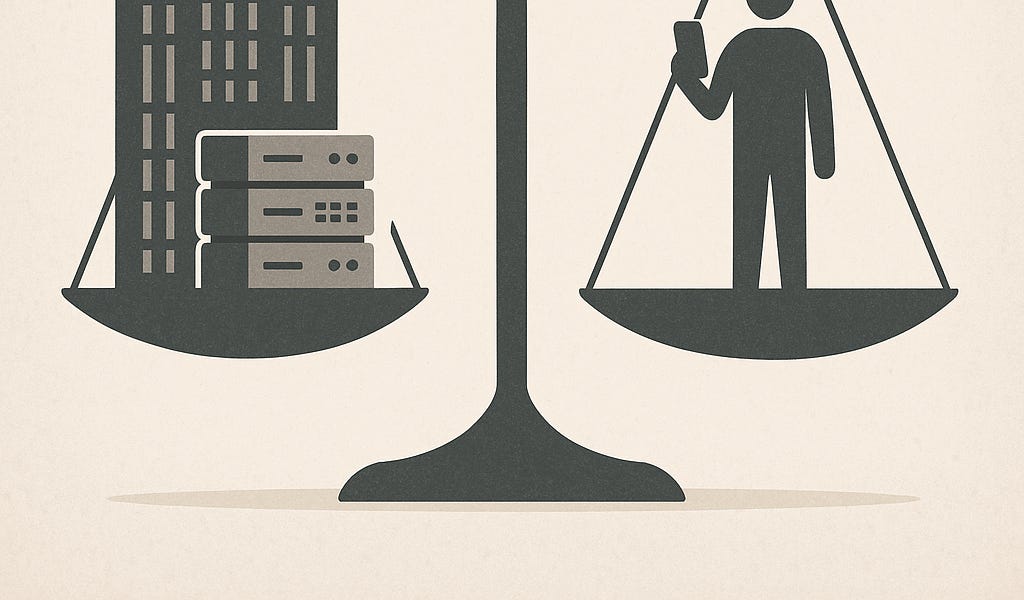

First, I want to ask about these price-tracking websites, do they update in real-time? Do they get their information from confidential data or public data? Do they alert to changes and, in the case of say, applying for an apartment, time the application submission at exactly the right time? Do they collaborate with each other? See, I just learned about algorithmic price fixing and how companies in nearly every industry, every facet of life, give their algorithms access to vast amounts of data, both public and private, and these algorithms share their data with each other, allowing companies to indirectly collude and fix prices without human intervention. What can we common folk do against that?
I’m just saying, you’re mentioning search engines, and the author says
So, how can I, with my spreadsheets and my search engine, possibly stand up to Big AI? David and Goliath was a nice fable, but now Goliath is back, and has friends, and laws protecting them, and all David has, is a sling and a single rock.